

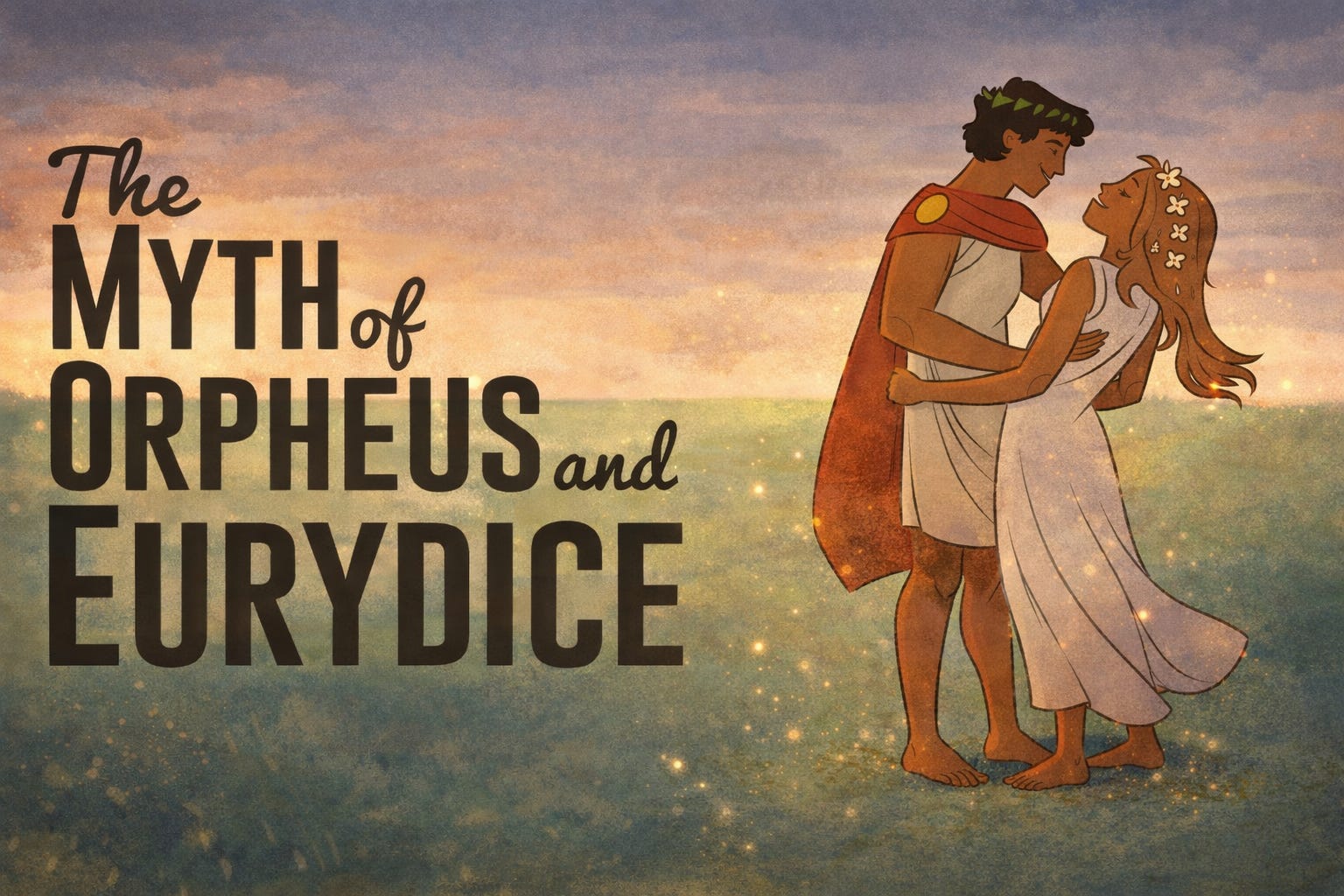
Are you familiar with the story of Orpheus and Eurydice? It’s a Greek mythology, part parable, part warning wrapped in tragedy. I’ve heard it told various ways, often showing up in other works like Shakespeare, tv shows like Netflix’s The Sandman, or movies like Hamnet, but it’s almost always framed the same way: as a love story. But what struck me recently is how it feels like a love story of a different kind. Or maybe that’s just where I am right now, because life is the hardest it’s ever been for me these days, and stories have a way of shifting when you’re inside something like that.
The tale most people know is one of a love ripped apart by death. Orpheus was a musician with a supernatural talent. When he played, the world stopped to listen. In some stories he is the son of a muse, so of course he would be more than just a human musician. He was married to Eurydice. Not much is written about her, which feels predictable given how often women were treated as background in these kinds of stories. But it is established that they had a great love. The story goes that shortly after they were wed, she is walking through a field and is startled by a man named Aristaeus. In her haste to get away, she steps on a snake and dies.
Orpheus is devastated. He cannot go on without her, so he does the unthinkable and goes beyond the veil to find her. He plays his music as he walks into the underworld, and the sound is so heartbreakingly beautiful it bends the rules of that place. Even Hades softens and offers him a deal. Eurydice can return to the land of the living, but there is one condition. Orpheus must walk ahead of her and not look back until they reach the surface.
No checking. No reassurances. No asking if she is still there. Just trust. Just faith.
He agrees, and they begin the climb. It is dark, long, and silent in the way only certain kinds of waiting can be. It doesn’t take long before doubt starts to creep in. Anyone who has ever waited in silence knows how quickly your mind fills the space. Maybe she is not there. Maybe the deal was never real. Maybe he has been walking alone this entire time, carrying hope like a weight he can’t quite set down.
Right as they reach the surface, he turns around, and she vanishes. Gone for good.
But what if it’s a love story of a different kind?
The story is so centered on Orpheus, so if I flip this around and look at it from Eurydice’s perspective, I start to wonder if she even wanted to return. What was her actual choice in any of this? Let’s imagine she is down there in the land of the dead, not suffering, but expanded. Reconnecting with ancestors. Living in a way that is no longer limited by her body, her womanhood, or the smallness of a single human life. In death, she has access to memory, understanding, and a kind of wholeness that feels less like an ending and more like a return.
Maybe in her version of the story, she did make a choice. On that walk to the surface, maybe she slowed down. Maybe she let the distance stretch between them. Enough space to plant doubt. Enough distance to make him turn around. Knowing the risk, but also shaping the outcome. Creating the exact conditions that would allow her to drift back to where she truly wanted to be.
Or maybe it is even simpler than that. What if Eurydice and Orpheus are the same? A split consciousness where Orpheus is the human self and Eurydice is the deeper soul.
In that version of the story, the descent into the underworld becomes incarnation. Density, time, grief, survival. The instruction not to look back becomes something else entirely. A quiet warning not to try to grasp the spiritual through force, control, or effort. And the turning back, the doubt, becomes the moment the human self tries to verify what can only be trusted.
Lately I feel tangled in my body, my emotions, bills, financial insecurity, survival. And at the same time, I am aware of something else running alongside all of it. Ancestry. Spirit. Meaning. A creative current that flickers in and out of reach. When the human part of me gets anxious, it feels like I have lost that tether. So I look back. I reach for reassurance. And every time I do, it feels like I create more distance instead of less, like trying to hold water tighter only makes it slip through faster.
To be human is to be fully immersed in the physical. Body, senses, emotions, personality. Without those familiar cues, it becomes hard to hold onto something less tangible. The knowing. The faith. That thin but steady thread that connects us to something beyond what we can see. And the more we try to find it through physical means, the more it recedes, just out of grasp.
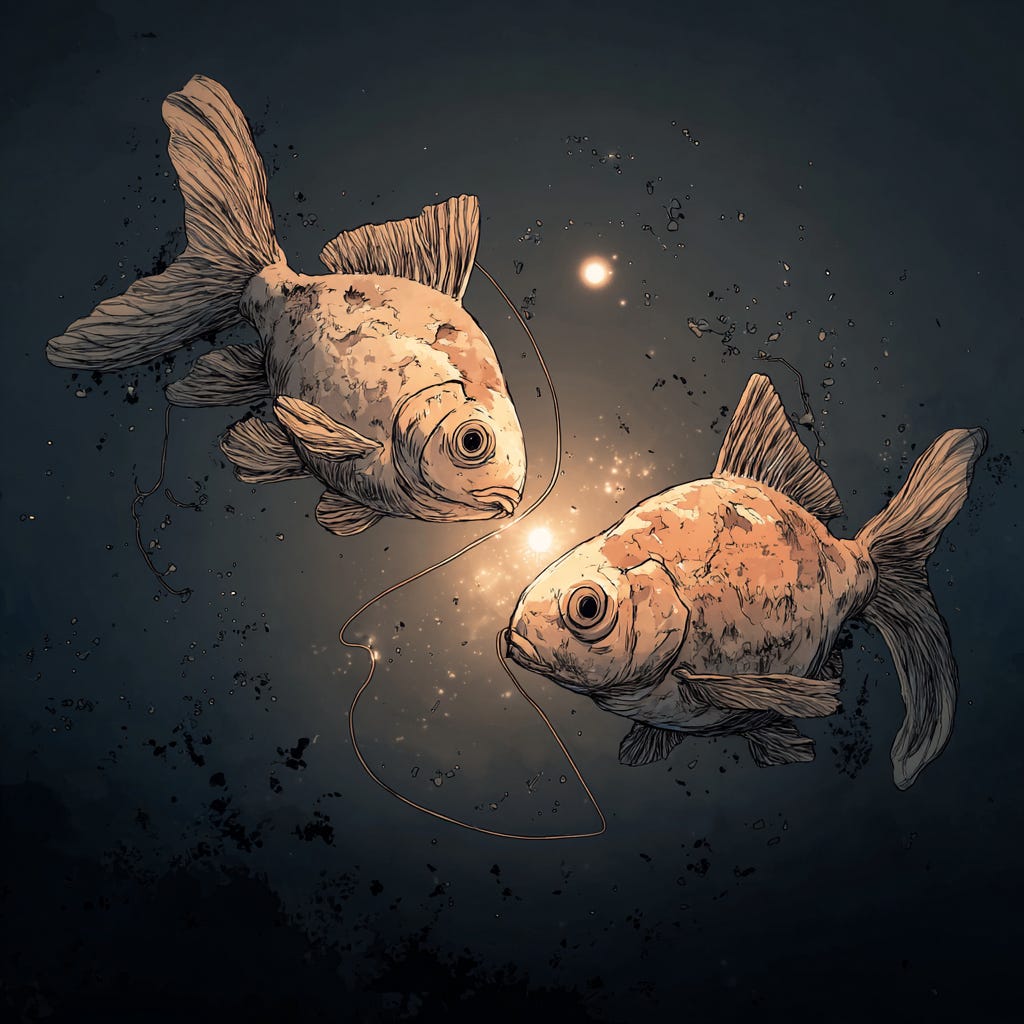
The image that keeps coming to mind is Pisces. Two fish swimming, one behind the other, connected by a cord. Moving in different directions, but never fully separate. That tension between them feels like the same tension I have been trying to name.
And after sitting with this for a while, something simple came to me. Our anxiety is not evidence that we have lost our spiritual tether. It is evidence that our nervous system is overloaded.
Spirit does not disappear when cortisol rises, but our access to it can blur, like a signal still present but harder to tune into.
For me, meditation has been the way back. A way to move out of the noise of my nervous system and settle into something quieter, something steadier. When I get there, I can feel that cord again, subtle but undeniable.
So whichever way you want to interpret this story, the truth is that there is always more to it than what we are first told. And perhaps the version we need is the one that meets us where we are.
Appreciated the flips of the script. Particularly Eurydice and Orpheus becoming one. And the image of Pisces led me to consider the possibility that the 2 fish and the tension between them is symbolic of the eletro-magnetic flow of energy within Earth's torus field. ❤️
I absolutely love this post! Flipping the script, then the complete change of perspective was brilliant. Definitely tossed me into a contemplative place of how often “I turn back.” Thank you 🙏🏼 so beautiful!